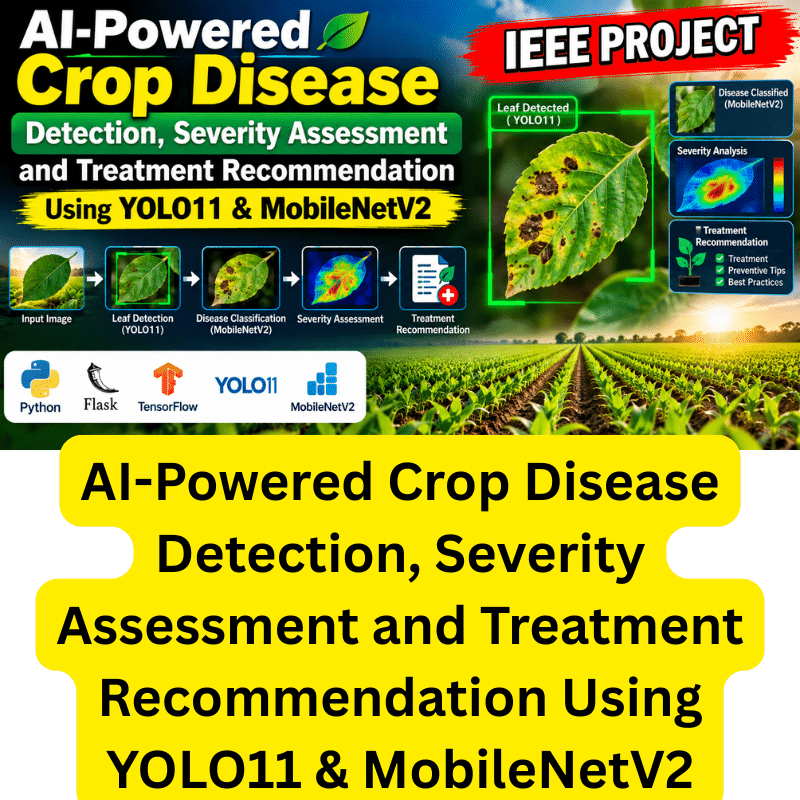
AI-Powered Crop Disease Detection, Severity Assessment and Treatment Recommendation Using YOLO11 & MobileNetV2
AI-Powered Crop Disease Detection, Severity Assessment and Treatment Recommendation Using YOLO11 & MobileNetV2
IEEE BASE PAPER TITLE:
Research on Crop Disease Identification Method Based on YOLOv9-MFD
IEEE BASE PAPER ABSTRACT:
In crop disease identification, environmental factors such as complex backgrounds, target occlusion, and illumination variations easily lead to missed detections and false detections. To address these issues, this paper proposes a crop disease identification method based on YOLOv9-MFD. First, a bounding box regression loss function based on MPDIoU is introduced to alleviate the problems of slow convergence and inaccurate localization across bounding boxes of different scales. Second, a Frequency Domain Network (FDN) is designed to project features into the frequency domain space, enabling noise to be distinguished from disease spot features, thereby filtering out background interference while preserving disease spot details. Finally, DynamicConv is adopted to expand the model’s representational capacity through a dynamic sparse activation mechanism, enlarging the parameter scale while keeping the increase in FLOPs at a low level. Experiments demonstrate that, compared with the original YOLOv9, YOLOv9-MFD achieves recall improvements of 1.6%, 1.8%, and 2.4%, precision improvements of 1.4%, 1.3%, and 2.1%, mAP@50 improvements of 1.4%, 1.7%, and 2.1%, and mAP@50-95 improvements of 1.7%, 1.2%, and 2.2% on the rice, tomato, and apple disease datasets, respectively. The model parameters increase from 51.0 M to 92.2 M (+41.2 M, +80.8%), FLOPs increase from 238.9 G to 244.3 G (+5.4 G, +2.3%), and FPS decreases from 67.1 to 59.2 (an average reduction of 7.9 frames per second), which still remains above the 30 FPS real-time detection threshold. The proposed method can effectively improve crop disease identification performance and provide a methodological reference for related research.
PROJECT OUTPUT VIDEO:
ALGORITHM/ MODEL USED:
YOLO11, MobileNetV2
OUR PROPOSED ABSTRACT:
Crop diseases are one of the major challenges affecting agricultural productivity and crop quality, making early and accurate disease identification important for effective crop management. Traditional disease identification generally depends on manual inspection of plant leaves, which can be time-consuming, requires agricultural expertise, and may become difficult when symptoms are visually similar across different diseases. An automated and intelligent system can assist in identifying crop diseases at an early stage and provide useful information for assessing disease severity and selecting appropriate management measures.
The proposed project, AI-Powered Crop Disease Detection, Severity Assessment and Treatment Recommendation Using YOLO11 & MobileNetV2, develops a web-based artificial intelligence system for automated crop leaf analysis. The system is developed using Python as the primary programming language, Flask as the web framework, and HTML, CSS, and JavaScript for the frontend interface. The developed system integrates two deep learning models to perform the diagnosis process. A fine-tuned YOLO11 model is used to detect and localize leaf regions in an input image, while a MobileNetV2 transfer-learning model is used to classify the detected leaf into one of 38 crop or plant disease classes. The trained MobileNetV2 classifier achieved an overall validation accuracy of 94.58%, while the YOLO11 leaf detector achieved 83.53% mAP@50, demonstrating the effectiveness of the combined detection and classification approach.
In addition to disease identification, the system estimates the severity of the detected disease using an HSV-based image analysis approach. It also incorporates Grad-CAM visualization to provide a heatmap highlighting the image regions that contribute to the classification result, thereby improving the interpretability of the deep learning prediction. Based on the identified crop disease and severity information, the system generates an agricultural recommendation along with indicative cost-related information. The recommendations are designed as general agricultural guidance and can be verified with appropriate agricultural experts before practical application.
The Flask-based application provides an interactive diagnosis interface through which users can upload a crop image. It supports both a Full Diagnosis mode, which performs leaf detection, disease classification, severity estimation, optional Grad-CAM visualization, and recommendation generation. The result interface presents the detected leaf regions, disease information, severity details, explanation, and recommendation. The system also provides model-performance visualizations, training metrics, confusion matrices, dataset class analysis, prediction-history charts, and downloadable PDF diagnosis reports.
Furthermore, the application supports plant-level progress tracking by allowing users to associate multiple diagnoses with a Plant ID. When multiple readings are available for the same plant, the system can display severity trends over time, helping users observe changes in plant health. By integrating object detection, transfer-learning-based image classification, severity estimation, explainable AI, and recommendation generation within a single web application, the proposed system provides an accessible AI-assisted approach for crop disease analysis and decision support. The system is intended as an academic and demonstration platform that can be further enhanced with a production database, larger and more diverse datasets, real-time agricultural data, and expert-validated recommendations.
SYSTEM REQUIREMENTS:
HARDWARE REQUIREMENTS:
- System : Pentium i3 Processor.
- Hard Disk : 20 GB.
- Monitor : 15’’ LED.
- Input Devices : Keyboard, Mouse.
- Ram : 8 GB.
SOFTWARE REQUIREMENTS:
- Operating System : Windows 10 / 11.
- Coding Language : Python 3.13.15.
- Web Framework : Flask.
- Frontend : HTML, CSS, JavaScript.
- Data Storage : JSON Files.
REFERENCE:
LIWEI CHEN, HUI PENG, YANCHAO LOU, ZHENXING MA, AND GULINAZI AILIMUJIANG, “Research on Crop Disease Identification Method Based on YOLOv9-MFD”, IEEE Access, Volume 14, 2026.
👉CLICK HERE TO BUY THIS PROJECT “AI-Powered Crop Disease Detection, Severity Assessment and Treatment Recommendation Using YOLO11 & MobileNetV2” SOURCE CODE👈
Frequently Asked Questions and Answers:
The main objective of the project is to develop an AI-based web application that can analyze crop leaf images, detect leaf regions, classify crop diseases, estimate disease severity, provide visual explanations, and generate treatment recommendations.
YOLO11 is used to detect and localize leaf regions in the input image. The detected leaf regions are then processed by the disease classification model.
MobileNetV2 is used for image classification. In this project, it classifies detected crop leaf images into the supported crop and disease categories.
The project training used 70,295 training images and 17,260 validation images
Grad-CAM is used to generate a heatmap that provides a visual representation of the regions associated with the model's classification result. It is included as part of the Full Diagnosis workflow.
Yes. The Full Diagnosis workflow includes a treatment recommendation component that produces recommendation information based on the diagnosis process.
JSON is used as a lightweight file-based mechanism for storing application information. It avoids the need for a separate relational database management system for the current implementation.
Yes. A research paper can be prepared based on the methodology, dataset, model architecture, experimental results, severity assessment, Grad-CAM analysis, and application implementation. The reported model performance can be included as part of the experimental evaluation. JP INFOTECH provides assistance in preparing International Journal Paper or International Conference Paper or IEEE Conference Paper. What is the main objective of this project?
Why is YOLO11 used in this project?
Why is MobileNetV2 used?
How many images were used for MobileNetV2 training and validation?
What is Grad-CAM used for?
Does the system provide treatment recommendations?
Why is JSON used in the project?
Can a research paper or journal publication be prepared from this project?