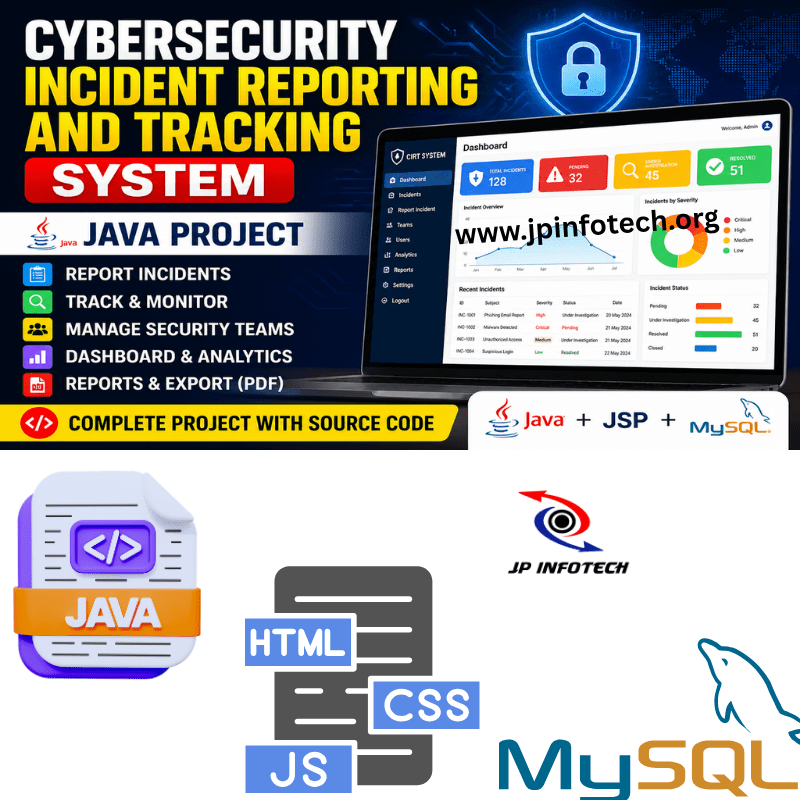
Cybersecurity Incident Reporting and Tracking System
Cybersecurity Incident Reporting and Tracking System
ABSTRACT:
The rapid growth of digital technologies and interconnected systems has significantly increased the frequency and complexity of cybersecurity threats across organizations. Cyber incidents such as phishing attacks, malware infections, unauthorized access, and data breaches can cause severe financial and reputational damage if not identified and managed promptly. In this context, an efficient and centralized system for reporting, tracking, and managing cybersecurity incidents becomes essential to ensure timely response, accountability, and improved organizational security posture.
The need for a Cybersecurity Incident Reporting and Tracking System arises from the limitations of traditional reporting mechanisms, which are often manual, unstructured, and lack real-time monitoring capabilities. Organizations require a streamlined platform where users can easily report incidents, security teams can efficiently analyze and respond to threats, and administrators can oversee the overall incident lifecycle. Such a system enhances transparency, ensures proper communication between stakeholders, and helps in maintaining a structured workflow for incident resolution.
The proposed system is a web-based application implemented using Java as the core programming language, with JSP, CSS, and JavaScript for the frontend interface, and MySQL as the backend database. The system is designed with three primary entities: User, Security Team, and Admin, each having specific roles and functionalities. The system has various incident security teams including SOC Team, Network Security, Application Security, Identity and Access Management, Cloud Security, Physical Security, Compliance and Legal, IT Security, Digital Forensics, and Endpoint Security.
Overall, the system ensures an organized, transparent, and efficient approach to cybersecurity incident management, improving response time, coordination, and decision-making within organizations.
PROJECT OUTPUT VIDEO:
EXISTING SYSTEM:
- The existing system for cybersecurity incident reporting and management was primarily based on conventional and semi-digital approaches used within organizations to handle security-related issues. In many cases, incidents were reported through emails, phone calls, helpdesk tickets, or manual forms submitted to the IT or security department. These methods relied heavily on human intervention for documenting, categorizing, and forwarding incidents to the appropriate teams. Each department maintained its own records, often using spreadsheets or standalone tools to track the status and progress of reported incidents.
- In the existing system, users typically communicated incidents by describing the issue in unstructured formats, which were then reviewed by IT personnel or security staff. Based on the nature of the incident, it was manually assigned to relevant teams such as network administrators, application support, or security specialists. The process involved multiple stages of communication, including acknowledgment, investigation, and resolution updates, which were often shared through emails or internal communication platforms.
- In the existing system, Security teams operated using their own monitoring tools and internal processes to analyze and respond to incidents. They maintained logs, investigation notes, and resolution details separately, depending on their domain expertise. Reporting and documentation were handled individually by each team, and periodic summaries or reports were generated for organizational review. These reports provided insights into incident types, response timelines, and resolution outcomes, helping organizations maintain records of cybersecurity activities.
- In the existing system, at the administrative level, oversight was achieved through compiled reports and manual tracking of key performance indicators. Administrators reviewed incident summaries, tracked ongoing issues, and ensured that security protocols were followed across departments. Analytical insights were derived from historical data maintained in various formats, enabling organizations to understand trends and improve their incident handling procedures over time. Overall, the earlier system established a foundational approach to cybersecurity incident reporting and management through coordinated efforts between users, security teams, and administrators.
DISADVANTAGES OF EXISTING SYSTEM:
- Lack of Centralized Management: The existing system operates through multiple independent channels such as emails, spreadsheets, and manual records, resulting in scattered data across departments. This absence of a centralized platform makes it difficult to maintain a unified view of all reported incidents, leading to challenges in coordination and overall incident management.
- Delayed Incident Reporting and Response: Since incident reporting depends on manual communication methods, there can be delays in notifying the appropriate security teams. The time taken to review, categorize, and assign incidents slows down the response process, which is critical in handling cybersecurity threats effectively.
- Limited Real-Time Tracking: In the existing system, Users and administrators often lack the ability to track incidents in real-time. Updates are typically communicated through periodic messages or reports, making it difficult to monitor the exact status of an incident at any given moment.
- Inefficient Communication Between Stakeholders: In the existing system, Communication between users, security teams, and administrators is not streamlined. Information exchange happens through separate channels, which can lead to miscommunication, missed updates, or incomplete information sharing during the incident lifecycle.
- Manual and Error-Prone Processes: In the existing system, many activities such as categorizing incidents, assigning teams, and updating statuses are handled manually. This increases the chances of human errors, inconsistencies in data entry, and duplication of records.
- Lack of Structured Incident Classification: In the existing system, Incidents are often reported in unstructured formats without predefined categories or severity levels. This makes it difficult to prioritize incidents and assign them to the appropriate teams efficiently.
- Difficulty in Performance Monitoring and Analysis: In the existing system, generating performance metrics such as response time, resolution rate, and team efficiency requires manual compilation of data. This makes it challenging for administrators to obtain accurate and timely analytical insights.
- Limited Transparency and Accountability: In the existing system, without a proper tracking mechanism, it becomes difficult to identify who is responsible for handling specific incidents and what actions have been taken. This reduces accountability and transparency within the system.
- Ineffective Documentation and Reporting: In the existing system, incident records are maintained in different formats and locations, making it hard to generate comprehensive reports. Historical data analysis becomes complex, affecting long-term security planning and decision-making.
- Scalability Challenges: As the number of users and incidents increases, the existing system struggles to handle the growing workload efficiently. Managing large volumes of incidents using manual or semi-digital methods becomes increasingly complex and time-consuming.
PROPOSED SYSTEM:
- The proposed system is a comprehensive web-based Cybersecurity Incident Reporting and Tracking System designed to provide a structured and integrated platform for managing cybersecurity incidents within an organization. The system is developed using Java as the core programming language, with JSP, CSS, and JavaScript used for designing an interactive and responsive user interface, and MySQL serving as the backend database for storing and managing incident-related data. The system is designed around three primary entities: User, Security Team, and Admin, each having clearly defined roles and functionalities to ensure smooth coordination and workflow.
- In the proposed system, the User entity, individuals can register and securely log in to the system to report cybersecurity incidents and track their status. The reporting process is structured with predefined incident categories such as Phishing Attack, Malware/Ransomware, Social Engineering, DDoS/Network Flooding, Unauthorized Access, Cloud Exposure, Web Vulnerability, Data Breach/Leakage, MFA/Password Bypass, Hardware Theft, and other security incidents. Users are required to provide detailed information including incident title, severity level (Low, Medium, High, Critical), assigned security team, incident description, and optional evidence or attachments. Each submitted incident is assigned a unique ticket ID, enabling users to view their incident history and monitor progress through different stages such as Submitted, Investigating, Resolved, and Closed, along with feedback and updates from the security team.
- The Security Team entity is designed for specialized teams including SOC Team, Network Security, Application Security, Identity and Access Management, Cloud Security, Physical Security, Compliance and Legal, IT Security, Digital Forensics, and Endpoint Security. Each team member can log in to access a dashboard that displays categorized incident reports such as new reports, incidents under analysis, resolved cases, and closed tickets. Through the incident queue, teams can view detailed information about active, resolved, and archived incidents, update the status of incidents, and record progression stages of investigation and resolution. The module also includes analytics and logging features that present performance-related data such as efficiency rate, number of critical incidents, and current workload, along with options to export reports in PDF format.
- The admin entity provides centralized monitoring and control over the entire system. The admin dashboard displays key metrics including total threats logged, pending triage cases, and threats neutralized, along with a live incident feed containing details such as incident ID, subject, department, severity, and status. The incidents section allows administrators to view comprehensive information including ticket details, incident context, assigned departments, risk levels, response status, history, and orchestration processes. Additionally, the analytics module offers graphical representations of incident lifecycle stages and identity distribution, along with a resolution performance index expressed in percentage.
- Overall, the proposed system defines a structured framework for reporting, categorizing, tracking, and managing cybersecurity incidents by integrating user interaction, security team operations, and administrative oversight within a single unified platform.
ADVANTAGES OF PROPOSED SYSTEM:
- Centralized Incident Management: The proposed system provides a unified platform where all cybersecurity incidents are reported, stored, and managed in a single database. This centralization ensures that users, security teams, and administrators have consistent access to accurate and up-to-date information, improving coordination across the organization.
- Faster Reporting and Response: With a structured reporting interface and predefined categories, users can quickly submit incidents without ambiguity. Automated assignment to the appropriate security teams reduces delays, enabling faster analysis and response to potential threats.
- Real-Time Tracking and Visibility: The proposed system allows users and stakeholders to track incidents in real-time using unique ticket IDs. Status updates such as Submitted, Investigating, Resolved, and Closed provide clear visibility into the progress of each incident, ensuring transparency throughout the lifecycle.
- Improved Communication and Collaboration: A single platform for interaction between users, security teams, and administrators enhances communication. Updates, feedback, and status changes are instantly reflected in the system, reducing miscommunication and ensuring that all stakeholders remain informed.
- Structured Incident Classification: The use of predefined categories and severity levels helps in organizing incidents systematically. This structure enables efficient prioritization, ensuring that critical issues receive immediate attention from the relevant teams.
- Enhanced Accuracy and Reduced Errors: In the proposed system, automation of processes such as incident assignment, status updates, and data storage minimizes manual intervention. This reduces the chances of human errors, duplication, and inconsistencies in incident records.
- Efficient Monitoring and Performance Analysis: The proposed system includes analytical features that provide insights into key metrics such as efficiency rate, critical incidents, workload, and resolution performance. These analytics help administrators and security teams evaluate performance and improve operational strategies.
- Transparency and Accountability: In the proposed system, each incident is tracked with detailed logs, including actions taken, status changes, and team involvement. This ensures accountability by clearly identifying responsibilities and maintaining a complete history of incident handling.
- Comprehensive Documentation and Reporting: In the proposed system, all incidents are systematically recorded and can be accessed for future reference. The system supports report generation and export options, enabling easy documentation for audits, compliance, and organizational reviews.
- Scalability and Flexibility: The proposed system is designed to handle increasing numbers of users and incidents without compromising performance. Its modular structure allows organizations to expand functionalities and adapt to evolving cybersecurity requirements.
SYSTEM REQUIREMENTS:
HARDWARE REQUIREMENTS:
- System : Pentium i3 Processor.
- Hard Disk : 20 GB.
- Monitor : 15’’ LED.
- Input Devices : Keyboard, Mouse.
- Ram : 8 GB.
SOFTWARE REQUIREMENTS:
- Operating system : Windows 10/11.
- Coding Language : Java.
- Frontend : JSP, CSS, JavaScript.
- JDK Version : JDK 23.0.1.
- IDE Tool : Apache Netbeans IDE 24.
- Tomcat Server Version : Apache Tomcat 9.0.84.
- Database : MySQL.
👉CLICK HERE TO BUY THIS PROJECT “Cybersecurity Incident Reporting and Tracking System” SOURCE CODE👈

You may also like

EV Charging Station Finder and Slot Booking
Detection of Hate Speech on Social Media Using Sentiment Analysis