
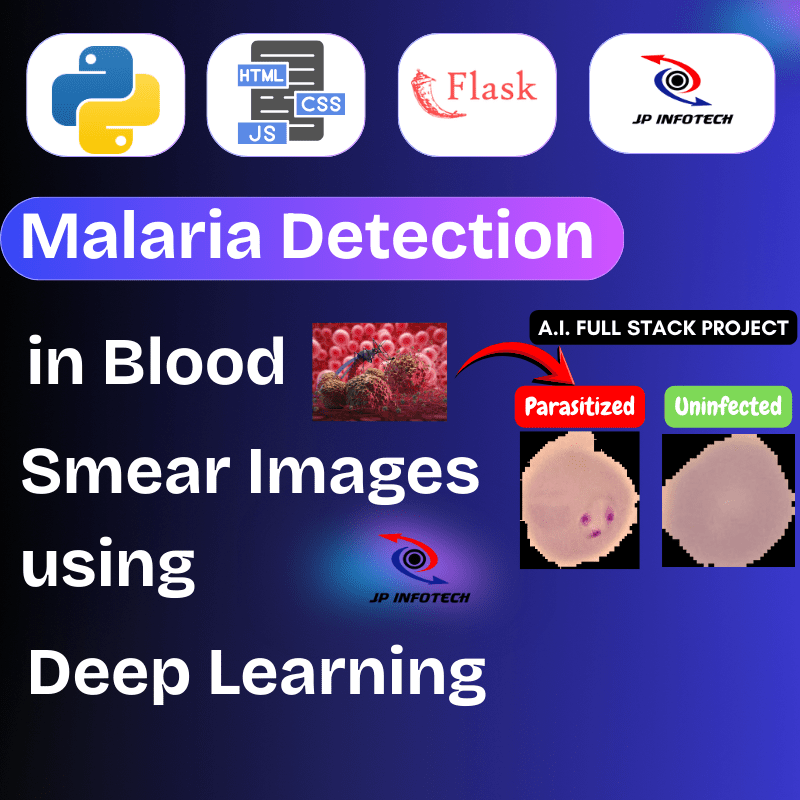
Malaria Detection in Blood Smear Images using Deep Learning
Malaria Detection in Blood Smear Images using Deep Learning
IEEE BASE PAPER TITLE:
Selective Intensity Ensemble Classifier (SIEC): A Triple-Threshold Strategy for Microscopic Malaria Cell Image Classification
IEEE BASE PAPER ABSTRACT:
Accurate malaria detection in resource-limited settings requires robust solutions—here, we introduce a selective intensity ensemble classifier (SIEC) that applies a triple-threshold strategy for enhanced microscopic image classification. This involves training three separate convolutional neural network models on the same images processed with different pixel-intensity thresholds: original, pixels above 100, and pixels above 200. This approach enables the ensemble to capture complementary low-, mid-, and high-intensity features, enhancing feature diversity and classification accuracy. The experiments were conducted on the publicly available Malaria Cell Dataset, consisting of 27,558 images. The proposed SIEC achieved an accuracy of 95.09%, with a precision of 95.27%, and matching recall and F1 scores of 95.09%, consistently outperforming six standard CNN models, including ResNet50, VGG16, Inception, and MobileNetV2. Notably, the combination of the 100-pixel filtered and original images yielded the highest classification performance, demonstrating the ensemble’s ability to integrate detailed and abstracted features effectively. These findings highlight SIEC as a promising and scalable solution for automated malaria detection and broader diagnostic imaging tasks.
PROJECT OUTPUT VIDEO:
ALGORITHM / MODEL USED:
InceptionV3 Architecture, MobileNetV2 Architecture.
OUR PROPOSED PROJECT ABSTRACT:
Malaria remains one of the most life-threatening infectious diseases worldwide, particularly affecting populations in developing regions where access to skilled medical professionals and diagnostic facilities is limited. Conventional malaria diagnosis through manual microscopic examination of blood smear images is time-consuming, labor-intensive, and highly dependent on expert interpretation, which may lead to diagnostic variability and delayed treatment. To address these challenges, this project focuses on the automated detection of malaria from blood smear images using deep learning techniques, aiming to improve diagnostic accuracy, efficiency, and accessibility.
The need for an intelligent, computer-aided diagnostic system arises from the growing demand for rapid and reliable malaria screening solutions that can assist healthcare professionals and reduce human error. Deep learning-based image analysis offers a promising approach by learning discriminative features directly from blood smear images, enabling precise differentiation between infected and healthy red blood cells.
In this work, “Malaria Detection in Blood Smear Images using Deep Learning” is developed using Python as the core programming language, with HTML, CSS, and JavaScript for the front-end interface, and Flask as the web framework to integrate the application components. The system utilizes a well-structured dataset consisting of two classes: Parasitized and Uninfected blood smear images. The training dataset includes 13,780 parasitized and 13,780 uninfected images, while the testing dataset contains 7,952 parasitized and 7,880 uninfected images, ensuring balanced and reliable model learning and evaluation.
The core of this system is two state-of-the-art deep learning models, Inception V3 and MobileNet V2, are implemented and evaluated for malaria detection. The Inception V3 model achieved a training accuracy of 95.1% and a testing accuracy of 94.7%, while the MobileNet V2 model demonstrated superior performance with a training accuracy of 95.6% and a testing accuracy of 95.5%. To provide a comprehensive evaluation, the system performs detailed performance analysis using metrics such as Accuracy, Precision, Recall, F-Measure, and Confusion Matrix. Additionally, visual analysis is presented through model accuracy comparison graphs, dataset distribution graphs, and training and testing image distribution graphs.
The developed system effectively demonstrates the potential of deep learning in automated malaria diagnosis, offering a reliable, scalable, and user-friendly solution that can support clinical decision-making and contribute to early detection and effective treatment of malaria.
SYSTEM REQUIREMENTS:
HARDWARE REQUIREMENTS:
- System : Pentium i3 Processor.
- Hard Disk : 20 GB.
- Monitor : 15’’ LED.
- Input Devices : Keyboard, Mouse.
- Ram : 8 GB.
SOFTWARE REQUIREMENTS:
- Operating System : Windows 10 / 11.
- Coding Language : Python 3.12.0.
- Web Framework : Flask.
- Frontend : HTML, CSS, JavaScript.
REFERENCE:
ABDULAZIZ ANORBOEV, SARVINOZ ANORBOEVA, JAVOKHIR MUSAEV, ESANBAY USMANOV, DOSAM HWANG, YEONG-SEOK SEO, AND JEONGKYU HONG, “Selective Intensity Ensemble Classifier (SIEC): A Triple-Threshold Strategy for Microscopic Malaria Cell Image Classification”, IEEE Access, VOLUME 13, 2025.
👉CLICK HERE TO BUY THIS PROJECT “Malaria Detection in Blood Smear Images using Deep Learning” SOURCE CODE👈
Frequently Asked Questions (FAQ’s) and Answers
The main objective of this project is to develop an automated system that detects malaria from microscopic blood smear images using deep learning techniques. The system classifies images into parasitized and uninfected categories to support accurate and efficient diagnosis.
The project is developed using Python as the core programming language. The frontend is built using HTML, CSS, and JavaScript, while Flask is used as the web framework. Deep learning models are implemented using TensorFlow and Keras.
The project uses two pretrained convolutional neural network models: Inception V3 and MobileNet V2. These models are fine-tuned on blood smear images to perform malaria classification.
The dataset consists of microscopic blood smear images categorized into parasitized and uninfected classes. The training dataset contains 13,780 parasitized and 13,780 uninfected images, while the testing dataset includes 7,952 parasitized and 7,880 uninfected images.
The user uploads a blood smear image through the web interface. The image is preprocessed and passed to the trained deep learning model. The system then predicts whether the image is parasitized or uninfected and displays the result to the user.
Model performance is evaluated using multiple metrics, including accuracy, precision, recall, F-measure, and confusion matrix. Visualization graphs such as model accuracy comparison and dataset distribution graphs are also used for analysis.
Both models perform well; however, MobileNet V2 achieves slightly higher training and testing accuracy compared to Inception V3, making it more efficient for malaria detection in this implementation.
Yes, the system provides a simple and intuitive web-based interface. Users can easily upload images and view prediction results without requiring technical knowledge of deep learning.
The system is primarily developed for academic and research purposes. With further validation, regulatory approval, and clinical integration, it can be adapted for real-world medical environments.
No. Model training benefits from GPU-enabled systems; however, for inference and testing, the system can run on standard computers with moderate hardware specifications. 1. What is the objective of the Malaria Detection project?
2. What technologies are used in this project?
3. Which deep learning models are used for malaria detection?
4. What type of dataset is used in the project?
5. How does the system work?
6. How is the performance of the models evaluated?
7. Which model performs better in this project?
8. Is the system user-friendly?
9. Can this system be used in real clinical environments?
10. Does the system require high-end hardware?

You may also like

Malicious and Phishing URL Detection Using Machine Learning

Employee Salary Prediction using Machine Learning