
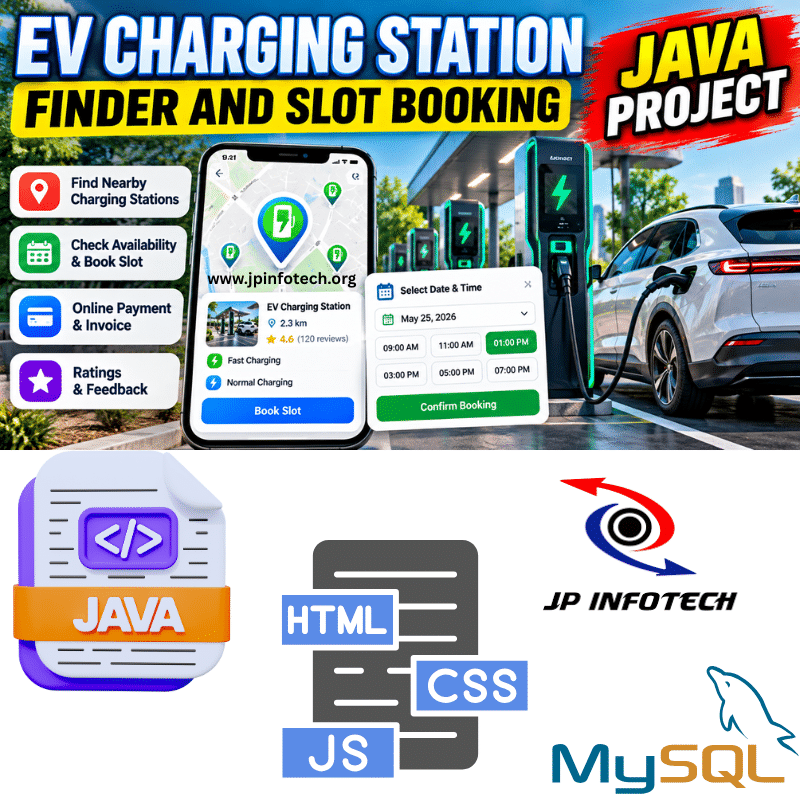
EV Charging Station Finder and Slot Booking
EV Charging Station Finder and Slot Booking
ABSTRACT:
The rapid adoption of Electric Vehicles (EVs) has created an increasing demand for easily accessible and efficiently managed charging infrastructure. Finding a suitable EV charging station, checking its availability, and reserving a charging slot can be challenging when such information is not available through a centralized platform. To address these challenges, the EV Charging Station Finder and Slot Booking system is developed as a web-based application that enables EV users to conveniently locate charging stations and reserve charging slots according to their requirements. The system provides an integrated platform for EV users, charging station operators, and administrators to manage the complete charging station and booking process.
The developed system allows users to register and log in to the application, search for charging stations based on city and location, view station details, identify nearby stations, and check available charging services. Charging stations support different charging categories such as FAST and NORMAL, with corresponding charging capacities and pricing. Users can select a preferred charging station, charging type, date, and time slot and make a booking based on the availability of the selected station. The system validates slot availability before confirming reservations, helping to avoid excessive bookings for the same charging period. Users can also view their booking history, monitor booking and payment status, complete payments, and obtain invoices for confirmed transactions.
The system provides a dedicated module for charging station operators to register and manage their stations, define charging capacities and pricing, monitor customer bookings, update booking status, and review customer feedback. Newly registered charging stations can be verified and approved by the administrator before becoming available to users. The administrator acts as the central controller of the system and can manage users, charging stations, bookings, payments, and feedback. The system also supports reporting functionality for monitoring charging station and booking activities. Users can provide ratings and comments after using a charging service, helping station operators evaluate customer satisfaction and improve their services.
The application is developed using Java as the primary programming language, with JSP, CSS, HTML, and JavaScript used to create the interactive web interface. MySQL is used as the backend database for securely storing user details, charging station information, charging slots, bookings, payments, invoices, and feedback. Java Servlets and JDBC are used to implement the application logic and database communication. Overall, the proposed system provides a centralized, user-friendly, and efficient solution for finding EV charging stations and managing charging slot reservations, thereby improving the convenience of EV users and simplifying charging station management.
PROJECT OUTPUT VIDEO:
EXISTING SYSTEM:
- The existing system for managing and locating Electric Vehicle (EV) charging stations primarily relies on conventional methods and individually managed charging station services. EV users generally identify charging stations through local information, online searches, maps, charging station websites, or dedicated applications provided by individual service providers. The availability of charging facilities, charging types, pricing, operating hours, and other station-related information may be maintained separately by each charging station operator.
- In the existing approach, users typically search for a suitable charging station based on their current location or intended travel route. After identifying a station, they may contact the station directly or use the service provider’s application or website to obtain information about charging availability. The user may then visit the station and request a charging facility. In some charging environments, reservations are handled manually through telephone communication, direct interaction with station staff, or through individual booking platforms.
- Charging station operators generally manage their stations independently. Information such as station details, charging capacity, charging type, pricing, and customer bookings is maintained according to the individual operator’s management process. Charging slot allocation may be handled using manual records or separate software systems. The operator is responsible for maintaining customer booking information and updating the status of charging requests.
- The existing system also involves separate activities for payment and transaction management. Users may make payments through the methods supported by the individual charging station, while transaction details and invoices may be maintained separately. Customer feedback and ratings, where available, are generally collected through the particular service provider’s platform or other external review platforms.
- From an administrative perspective, charging station management is generally performed through separate systems maintained by individual organizations. Station registration, verification, booking management, payment records, and customer information may therefore exist in different environments. There is no single standardized platform connecting EV users, charging station operators, and administrators throughout the complete charging reservation process.
- Thus, the existing system mainly focuses on finding charging facilities and obtaining charging services through individually managed platforms and conventional booking processes. Charging station information, slot management, user bookings, payments, and customer feedback are handled according to the facilities and procedures provided by individual charging service providers.
DISADVANTAGES OF EXISTING SYSTEM:
- Lack of Centralized Charging Station Information: The existing system does not provide a single centralized platform containing comprehensive information about EV charging stations. Users may need to search across different applications, websites, or other sources to identify suitable charging facilities.
- Difficulty in Finding Nearby Charging Stations: Users may find it difficult to quickly identify charging stations based on their location. Information about the distance and geographical location of available stations may not be consistently provided across different platforms.
- Limited Charging Slot Reservation: In conventional charging environments, users may need to contact the charging station directly or visit the station to obtain a charging facility. A structured online mechanism for selecting and reserving a specific charging slot may not be available.
- Unclear Slot Availability: The existing system approach may not provide real-time information about the number of available charging slots for a particular charging type and time. Users may therefore have limited visibility into the current charging capacity of a station.
- Separate Charging Station Management: Charging station operators generally manage their facilities independently. Station details, charging capacity, pricing, bookings, and customer information may be maintained using separate systems or manual records.
- Manual Booking Management: When bookings are handled through telephone communication, direct interaction, or manual records, maintaining and updating reservation information requires additional effort. Tracking pending, confirmed, completed, and cancelled bookings can also become difficult.
- Limited Payment and Invoice Integration: Payment processing may be handled separately from the charging reservation process. Users may not have an integrated mechanism for viewing payment status and obtaining booking-related invoices within the same platform.
- Scattered Customer Feedback: Customer ratings and feedback may be collected through different platforms or individual service providers. This makes it difficult to maintain a centralized record of customer experiences for each charging station.
- Limited Administrative Control: The existing system may not provide a unified administrative environment for managing users, charging stations, bookings, payments, and customer feedback. Administrative activities may therefore depend on multiple independent systems.
- Lack of Integrated Reporting: Information related to charging station usage, bookings, payments, and customer feedback may not be available through a common reporting mechanism. This limits the ability of station operators and administrators to obtain a consolidated view of system activities.
- Time-Consuming Charging Process: Users may have to spend additional time searching for an appropriate station, checking its availability, communicating with the operator, and completing the booking process. The absence of an integrated workflow can make charging arrangements less convenient.
- Limited User Convenience: The existing system does not provide a complete end-to-end environment combining station discovery, location-based search, charging type selection, slot reservation, booking management, payment, invoice generation, and feedback. As a result, users may need to depend on multiple processes or platforms to complete their charging requirements.
PROPOSED SYSTEM:
- The proposed system, EV Charging Station Finder and Slot Booking, is a web-based application designed to provide a centralized platform for electric vehicle users to search for charging stations and reserve charging slots. The system brings EV users, charging station operators, and administrators into a common application. It is developed using Java as the programming language, with JSP, CSS, and JavaScript for the frontend and MySQL as the database.
- The proposed system provides a registration and login facility for EV users. After authentication, users can access the charging station search and booking functions. User details are stored in the MySQL database and are associated with their charging station bookings, payments, and feedback. The application maintains the required user information to support the different activities performed within the system.
- The charging station finder module allows users to search for registered EV charging stations based on location and city. The system maintains station information including station name, address, city, contact details, latitude, longitude, charging type, charging capacity, and pricing. The geographical information is used to identify charging stations according to their location and to support the identification of nearby charging facilities.
- The proposed system supports different charging categories, particularly FAST and NORMAL charging. Charging station operators can configure the charging capacity and pricing associated with the available charging types. When users select a station, they can view the relevant charging information and select the required charging category according to their charging requirements.
- The system provides an online charging slot booking facility. Users can select a charging station, charging type, booking date, and preferred time before submitting a reservation request. The application checks the existing booking and slot usage information before processing the request. The selected booking information is then stored in the database and associated with the respective user and charging station.
- A dedicated module is provided for charging station operators to register and manage their charging stations. Operators can enter station information, location details, charging types, available capacity, and pricing information. The registered station details are submitted to the administrator for verification. The administrator can review the station information and approve or reject the registration before the station is made available through the user-facing charging station search.
- The system maintains the booking lifecycle associated with charging reservations. Users can view their booking information through their account, while charging station operators can access incoming reservations and manage their booking status. The application records different stages of a booking, including pending, booked, completed, and cancelled states, allowing the reservation information to be maintained throughout the charging process.
- Payment functionality is incorporated into the booking workflow. Payment details are associated with the respective charging reservation, and the system maintains information such as the payment amount and payment status. The application also provides invoice generation for completed transactions. The invoice contains relevant booking and payment information, including customer details, charging station information, charging type, booking date and time, and the applicable amount.
- The proposed system also incorporates a feedback and rating mechanism. After using a charging service, users can submit ratings and comments related to the charging station. The feedback is stored in the database and associated with the respective station and user. This information can subsequently be viewed and managed through the appropriate system modules.
- An administrator module is included for centralized management of the application. The administrator can manage registered users, charging station registrations, station approval activities, bookings, payments, and customer feedback. The administrator can also access relevant system records and reports to monitor the activities performed within the platform.
- MySQL is used as the centralized database for maintaining the different types of application data. User accounts, charging station details, charging capacity, slot usage, bookings, payments, invoices, and feedback are stored in the database. Java Servlets and JDBC are used to implement the application processing and database communication, while JSP pages provide the dynamic web interface.
- Overall, the proposed EV Charging Station Finder and Slot Booking system establishes an integrated workflow for charging station discovery and reservation. The system covers user registration, station searching, location-based station identification, charging type selection, slot booking, station management, station approval, payment processing, invoice generation, feedback management, and administrative control within a single Java-based web application.
ADVANTAGES OF PROPOSED SYSTEM:
- Centralized Charging Station Information: The proposed system provides a centralized platform for maintaining and accessing EV charging station information. Users can view station details, location, charging type, capacity, pricing, and contact information from a common application.
- Convenient Station Search: Users can search for suitable charging stations based on city and location. The system also uses geographical information to identify nearby charging facilities, making station discovery more convenient.
- Online Charging Slot Booking: The proposed system allows users to select a charging station, charging type, date, and preferred time slot and make a booking online. This provides a structured reservation process without requiring direct communication with the station operator.
- Charging Capacity Management: The proposed system maintains charging capacity and slot usage information for different charging types. This allows bookings to be processed according to the available capacity of the selected station and time period.
- Support for Multiple Charging Types: The proposed system supports FAST and NORMAL charging categories. Operators can define the available capacity and pricing for different charging services, while users can select the charging type required for their vehicle.
- Efficient Booking Management: All booking information is stored systematically in the database. Users can view their reservations, while charging station operators can manage incoming bookings and update their status throughout the charging process.
- Integrated Payment Management: Payment information is associated with the respective charging booking. The system maintains payment amounts and transaction status, providing a structured approach to managing charging-related transactions.
- Automated Invoice Generation: The proposed system provides invoice generation for charging transactions. Relevant customer, station, booking, and payment information can be included in the invoice, providing users with a formal record of their transaction.
- Station Operator Management: Charging station operators have their own management functionality for registering stations, maintaining charging information, monitoring bookings, and managing charging-related activities through the application.
- Controlled Station Approval: The administrator can review and approve charging station registrations before they become available to users. This provides centralized control over the charging stations listed in the system.
- Centralized Administrative Control: The administrator can manage users, charging stations, bookings, payments, and feedback from a common administrative environment. This provides centralized supervision of the major activities within the application.
- Customer Feedback and Rating: Users can submit ratings and comments for charging stations after using the service. The system maintains this feedback for reference by station operators and administrators.
- Organized Data Management: MySQL provides centralized storage for user details, station information, charging slots, bookings, payments, invoices, and feedback. This enables systematic storage and retrieval of application data.
- Improved User Convenience: The complete workflow from charging station search to slot booking, payment, and invoice generation is provided through a single web application. Users can perform the required charging-related activities without depending on multiple independent platforms.
- Reporting and Monitoring: The proposed system maintains charging station and booking records that can be used for reporting and monitoring. Administrators and station operators can access relevant information to understand charging and reservation activities.
- Web-Based Accessibility: Since the proposed system is developed as a web application using Java, JSP, CSS, and JavaScript, users, station operators, and administrators can access their respective functionalities through a web browser without requiring a separate desktop application.
SYSTEM REQUIREMENTS:
HARDWARE REQUIREMENTS:
- System : Pentium i3 Processor.
- Hard Disk : 20 GB.
- Monitor : 15’’ LED.
- Input Devices : Keyboard, Mouse.
- Ram : 8 GB.
SOFTWARE REQUIREMENTS:
- Operating system : Windows 10/11.
- Coding Language : Java.
- Frontend : JSP, CSS, JavaScript.
- JDK Version : JDK 23.0.1.
- IDE Tool : Apache Netbeans IDE 24.
- Tomcat Server Version : Apache Tomcat 9.0.84
- Database : MySQL Workbench 8.0.
👉CLICK HERE TO BUY THIS PROJECT “EV Charging Station Finder and Slot Booking” SOURCE CODE👈

You may also like
Cybersecurity Incident Reporting and Tracking System

Detection of Hate Speech on Social Media Using Sentiment Analysis