
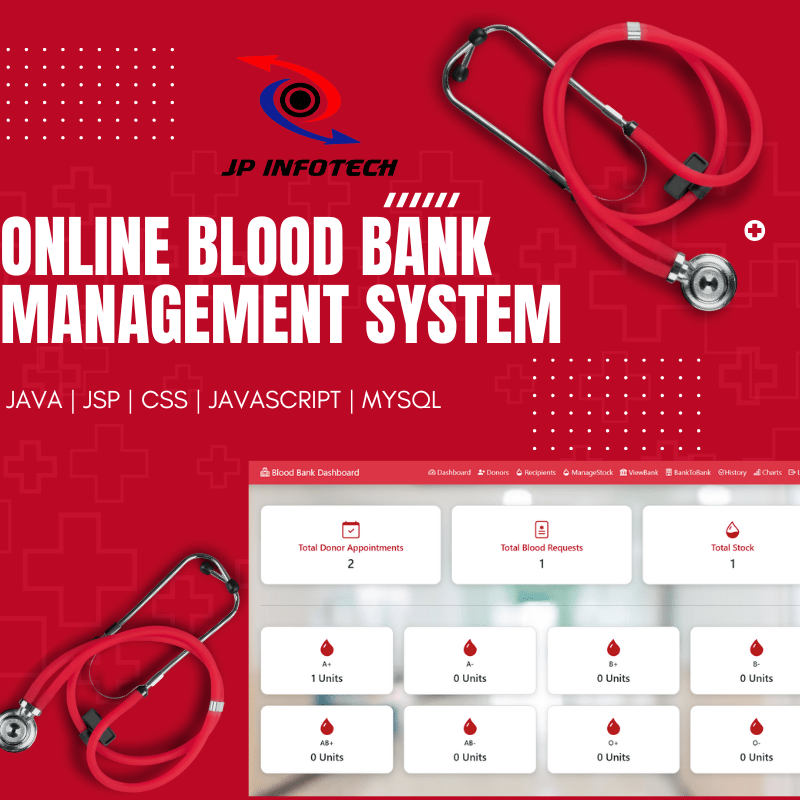
Online Blood Bank Management System
Online Blood Bank Management System
ABSTRACT:
A blood bank plays a crucial role in healthcare by collecting, storing, and providing safe blood to patients in need of transfusion during emergencies, surgeries, or medical treatments. With the growing demand for blood and the increasing challenges of maintaining accurate records, manual blood bank systems often face issues such as delays, mismanagement of stock, lack of transparency, and unauthorized access. Therefore, there is a strong need for a digital solution that ensures efficiency, reliability, and security in managing blood donation and distribution processes.
To address these challenges, the Online Blood Bank Management System has been developed using Java as the programming language, with JSP, CSS, and JavaScript for the frontend, and MySQL as the database. The system is designed with four main entities: Admin, Blood Bank, Donor, and Recipient.
This system is designed to streamline and digitalize the processes involved in blood bank operations, enabling effective management of donors, recipients, and blood banks while ensuring transparency and security. The need for such a system arises from the growing demand for timely access to blood, the challenges faced in maintaining accurate records, and the necessity to minimize unauthorized access or misuse. By introducing an integrated and automated solution, this project addresses the inefficiencies of manual systems and provides an accessible, reliable, and user-friendly platform for all stakeholders involved in blood donation and request management.
This system provides a secure, automated, and transparent platform for blood management. By integrating dashboards, dynamic charts, and automated calculations, it improves efficiency, reduces delays in blood availability, and fosters a culture of voluntary blood donation. Ultimately, the Online Blood Bank Management System enhances healthcare support by ensuring that life-saving blood reaches those in need in a timely manner.
PROJECT OUTPUT VIDEO:
EXISTING SYSTEM:
- In the existing system, the management of blood banks was primarily carried out through manual processes. Records of donors, recipients, and available blood stock were maintained using paper-based registers or basic spreadsheet files. Blood banks had to manually update the details of blood donations, requests, and stock availability, which required significant time and human effort.
- In the existing system, donors were usually informed about blood donation camps and requests through offline communication methods such as phone calls, notices, or local announcements. Similarly, recipients or patients in need of blood had to directly visit blood banks or rely on hospital staff to check for availability. The exchange of blood units between different banks, if needed, was coordinated through manual communication channels, often involving direct contact between blood bank officials.
- In the existing system, the approval and verification of donors and recipients were generally managed in person. Verification documents were physically submitted, and records were stored for future reference in files or registers. Reports and summaries, such as the total number of donors, recipients, and available stock, were prepared manually at regular intervals.
- Overall, the existing system operated with a conventional record-keeping and communication approach, where most of the tasks such as donor registration, recipient requests, and stock maintenance were performed through human effort without automation.
DISADVANTAGES OF EXISTING SYSTEM:
Although the earlier manual system was functional, it had several drawbacks that limited its efficiency and reliability. Some of the major disadvantages include:
- Time-Consuming Processes: In the existing system, since records were maintained manually on paper or spreadsheets, updating information about donors, recipients, and blood stock consumed significant time and effort. This often cause delays in providing blood to patients in urgent situations.
- Lack of Real-Time Information: In the existing system, donors, recipients, and even healthcare providers had no immediate access to real-time data regarding blood availability. This made it difficult to quickly locate and obtain the required blood group during emergencies.
- Prone to Human Errors: In the existing system, manual record-keeping increased the chances of errors in data entry, misplacement of documents, and duplication of information. Such errors could lead to confusion in managing blood stocks and donor-recipient details.
- Inefficient Communication: In the existing system, donors and recipients were informed through traditional communication methods such as phone calls or notices, which were slow and not always reliable. Similarly, coordination between blood banks for stock exchange was cumbersome.
- Limited Transparency and Monitoring: Since in the existing system, most data was stored in files or registers, it was difficult for administrators to monitor donor activities, blood requests, and overall stock levels effectively. Generating detailed reports and summaries required manual effort.
- Restricted Accessibility: In the existing system, donors and recipients had to physically visit the blood bank or hospital to register, check availability, or request blood. This made the system less accessible and less user-friendly, particularly for people in remote areas.
PROPOSED SYSTEM:
- The proposed system, titled Online Blood Bank Management System, is a web-based application developed using Java as the backend programming language, JSP, CSS, and JavaScript for the frontend interface, and MySQL as the database. This system is designed to digitalize and streamline the operations of blood banks by integrating all stakeholders: Admin, Blood Bank, Donor, and Recipient—into a single online platform.
- In our proposed system, the admin serves as the main controller of the system. Only after the admin’s approval can new blood banks, donors, and recipients gain access. Admin functionalities include monitoring dashboards, managing pending approvals, maintaining donor and recipient records, verifying registered blood banks, and analyzing data through dynamic charts.
- The Blood Bank module enables individual banks or hospitals to manage donor appointments, recipient requests, and their blood stock details. Blood banks can also view other banks’ stock availability, raise requests for blood units, and respond to requests from other banks. Additional features include history maintenance for both donations and requests, as well as interactive charts to analyze stock levels and request statuses.
- The Donor module allows individuals to register, book donation appointments, and view donation history. The system also enforces a three-month waiting period between donations, and donors can download certificates for their contributions to encourage participation.
- The Recipient module enables users in need of blood to register, view available blood banks, place requests for required blood groups, and track the status of their requests. A personal dashboard allows recipients to monitor pending and completed requests in a user-friendly manner.
- By connecting all entities under a unified online system, the proposed design ensures structured workflows for blood collection, stock management, and request handling, while also maintaining records for transparency and future reference.
ADVANTAGES OF PROPOSED SYSTEM:
The Online Blood Bank Management System overcomes the limitations of the existing manual system by providing an automated, secure, and well-organized digital platform. The major advantages of the proposed system are:
- Time Efficiency: The proposed system automates processes such as donor registration, recipient requests, and stock management, significantly reducing the time required for operations compared to manual record-keeping.
- Real-Time Information Access: In the proposed system, donors, recipients, and blood banks can access updated information instantly. Stock availability for each blood group is displayed in real time, enabling faster decision-making during emergencies.
- Data Accuracy and Reliability: With centralized digital records, the chances of errors, duplication, or data loss are minimized. Automated updates ensure that donor, recipient, and stock information remain accurate and consistent.
- Improved Communication: The system provides seamless online communication between donors, recipients, and blood banks. Notifications and updates are sent automatically, ensuring better coordination and reducing delays.
- Transparency and Monitoring: In the proposed system admins and blood banks can easily track donation history, blood requests, and stock details. Interactive dashboards and charts provide clear insights into ongoing activities and resource availability.
- Enhanced Security and Verification: The approval mechanism ensures that only verified donors, recipients, and blood banks can access the system. This prevents unauthorized usage and ensures reliability.
- Convenience and Accessibility: In the proposed system, donors and recipients can register, request blood, or book appointments online without visiting the blood bank physically. This makes the system more accessible to users across different locations.
- Motivation for Donors: By providing downloadable donation certificates and maintaining a transparent donation history, the system encourages more individuals to participate actively in blood donation drives.
SYSTEM REQUIREMENTS:
HARDWARE REQUIREMENTS:
- System : Pentium i3 Processor.
- Hard Disk : 20 GB.
- Monitor : 15’’ LED.
- Input Devices : Keyboard, Mouse.
- Ram : 8 GB.
SOFTWARE REQUIREMENTS:
- Operating system : Windows 10/11.
- Coding Language : JAVA.
- Frontend : JSP, CSS, JavaScript.
- JDK Version : JDK 23.0.1.
- IDE Tool : Apache Netbeans IDE 24.
- Tomcat Server Version : Apache Tomcat 9.0.84
- Database : MYSQL.
👉CLICK HERE TO BUY THIS PROJECT “Online Blood Bank Management System” SOURCE CODE👈
Frequently Asked Questions (FAQ’s) and Answers
1. What is the Online Blood Bank Management System?
The Online Blood Bank Management System is a web-based platform developed using Java, JSP, CSS, JavaScript, and MySQL that digitalizes the management of blood banks. It integrates four entities—Admin, Blood Bank, Donor, and Recipient—into a single system to handle registrations, appointments, blood stock management, and blood requests effectively.
2. Why is this system needed?
This system is needed to overcome the challenges of manual blood bank management, such as delays, errors, and lack of transparency. It ensures quick access to blood availability, secure verification of users, efficient donor appointment management, and timely processing of recipient requests.
3. Who are the main users of the system?
The system has four primary users: Admin – Central controller who approves and manages all users and monitors activities. Blood Bank – Manages donors, recipients, and stock. Donor – Books appointments for blood donation and views history. Recipient – Requests blood and tracks the status of requests.
4. What are the key features of the admin module?
Approve or reject new blood banks, donors, and recipients. Monitor the dashboard with statistics of users and blood banks. View and manage donors, recipients, and registered blood banks. Analyze data using dynamic charts for blood stock and user activities.
5. How does the Blood Bank module work?
The Blood Bank module allows blood banks to: Manage donor appointments and update stock upon completed donations. View and process recipient requests. Check stock details by blood group. Request blood from other banks and respond to inter-bank requests. Maintain history of donations and requests. Analyze blood stock and requests through dynamic charts.
6. What are the donor’s functionalities in the system?
View dashboard with details like blood group and last donation date. Book appointments for donation by selecting a blood bank and date. Maintain history of donations and download donation certificates. Comply with the three-month donation interval rule enforced by the system.
7. How can recipients use the system?
Recipients can: View their dashboard with pending requests. Search blood banks and request the required blood group. Track request status as pending, approved, or rejected.
8. How does the system ensure security and authenticity?
Only admin-approved users (donors, recipients, and blood banks) can access the system. Verification during registration prevents unauthorized or fake accounts. Sensitive information is stored securely in the MySQL database.
9. What technologies are used in the project?
Backend: Java Frontend: JSP, CSS, JavaScript Database: MySQL
10. How does this system benefit society?
The system improves blood donation and distribution efficiency, reduces delays, increases transparency, and motivates more people to donate through features like downloadable certificates. By ensuring timely availability of blood, it plays a crucial role in saving lives.

You may also like

EV Charging Station Finder and Slot Booking

Cybersecurity Incident Reporting and Tracking System