
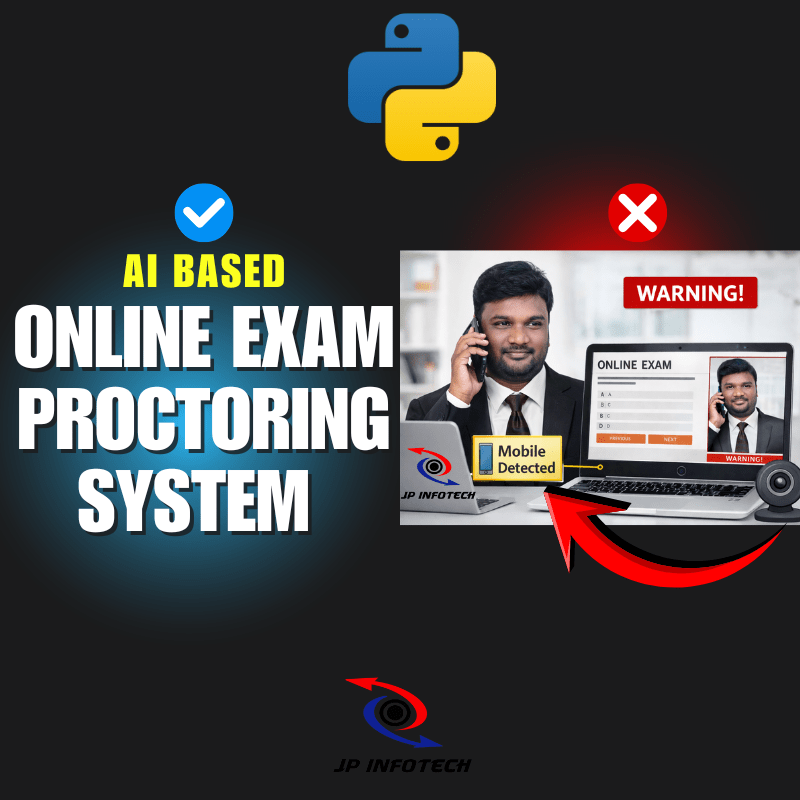
Online Exam Proctoring System using Deep Learning
Online Exam Proctoring System using Deep Learning
IEEE BASE PAPER TITLE:
Enhancing Academic Integrity in E-Exams Through AI-Driven Proctoring Technologies
IEEE BASE PAPER ABSTRACT:
The rapid adoption of e-exams in education has revolutionized the assessment landscape, offering flexibility and accessibility to learners worldwide. However, this shift has also raised significant concerns about academic integrity. This study explores the role of artificial intelligence (AI)-driven proctoring technologies in mitigating cheating and fostering fairness in online examinations. Key features of AI-driven proctoring, including facial recognition, gaze tracking, keystroke analysis, and behavioral pattern detection, are analyzed for their effectiveness in ensuring a secure testing environment. The research highlights the challenges associated with these technologies, such as privacy concerns, potential biases, and technical limitations, while proposing solutions to address them. Through a mixed-methods approach combining case studies and surveys, the study evaluates the impact of AI-driven proctoring on student performance, engagement, and trust in e-exam systems. The findings suggest that integrating ethical AI practices and transparent communication can enhance academic integrity while maintaining learner confidence. This research contributes to the ongoing discourse on leveraging technology to uphold educational standards in an increasingly digital world.
PROJECT OUTPUT VIDEO:
ALGORITHM / MODEL USED:
YOLOv5.
OUR PROPOSED PROJECT ABSTRACT:
The rapid growth of online education and remote assessments has created a strong demand for secure, reliable, and scalable examination systems that can ensure academic integrity without physical supervision. Traditional online examination platforms largely depend on manual monitoring or basic rule-based checks, which are often ineffective in detecting sophisticated cheating behaviors such as the use of mobile phones, books, or deliberate webcam manipulation. This limitation highlights the need for an intelligent, automated proctoring mechanism capable of monitoring candidates in real time and responding instantly to violations.
To address these challenges, this project presents an Online Exam Proctoring System using Deep Learning, designed and implemented using Python as the core programming language, Django as the web framework, and HTML, CSS, and JavaScript for an interactive and responsive frontend. The system integrates the YOLO (You Only Look Once) deep learning model for real-time object detection to identify examination violations through webcam monitoring. YOLO5 enables accurate detection of prohibited objects and abnormal behaviors, making the proctoring process efficient and practical for real-world deployment.
The developed system follows a role-based architecture with three primary entities: Admin, Student, and Teacher. The Admin acts as the central authority, responsible for approving teacher registrations, managing students, courses, and questions, and monitoring overall system statistics through a comprehensive dashboard. The Teacher entity ensures controlled content creation, where only admin-approved teachers can log in to manage courses, prepare and maintain question banks, and upload study materials for students. This approval-based access control significantly enhances system security and prevents unauthorized access.
The Student entity forms the core user-facing component of the system. Students register with complete personal and identity details and can access dashboards, available examinations, study materials, and automatically evaluated results. During examinations, the webcam is activated, and the YOLO-based violation detection module continuously monitors the candidate. The system issues warnings for the first three detected violations and automatically terminates the examination upon repeated misconduct, thereby enforcing strict examination rules. The system also supports multiple exam attempts, with each attempt recorded and evaluated independently, ensuring transparency and fairness.
Overall, the proposed system offers an intelligent, automated, and secure online examination environment by combining web technologies with deep learning-based real-time proctoring. It significantly reduces the need for human invigilation, minimizes malpractice, and provides a scalable solution suitable for educational institutions conducting remote assessments.
SYSTEM REQUIREMENTS:
HARDWARE REQUIREMENTS:
- System : Pentium i3 Processor.
- Hard Disk : 20 GB.
- Monitor : 15’’ LED.
- Input Devices : Keyboard, Mouse.
- Ram : 8 GB.
- Camera : Web camera.
SOFTWARE REQUIREMENTS:
- Operating System : Windows 10 / 11.
- Coding Language : Python 3.12.0
- Web Framework : Django.
- Frontend : HTML, CSS, JavaScript.
REFERENCE:
Wai Yie Leong, “Enhancing Academic Integrity in E-Exams Through AI-Driven Proctoring Technologies”, IEEE Conference, 2025.
👉CLICK HERE TO BUY THIS PROJECT “Online Exam Proctoring System using Deep Learning” SOURCE CODE👈
Frequently Asked Questions (FAQ’s) and Answers
The Online Exam Proctoring System using Deep Learning is a web-based platform designed to conduct secure online examinations. It integrates deep learning–based real-time monitoring with an online exam management system to detect violations and maintain academic integrity during remote assessments.
The system is developed using Python as the core programming language, Django as the web framework, and HTML, CSS, and JavaScript for the frontend. The proctoring mechanism uses the YOLO deep learning model for real-time object and behavior detection through webcam monitoring.
During the examination, the system activates the student’s webcam and continuously analyzes video frames using the YOLO model. It detects predefined violations such as the presence of mobile phones, books, absence from the camera frame, or webcam obstruction. Detected violations trigger warnings or exam termination based on system rules.
The system issues warnings for the first three detected violations. If the student exceeds the allowed number of violations, the examination is automatically terminated, and the student is not allowed to continue that exam session.
Yes. The system supports multiple exam attempts. Each attempt is recorded separately, and the corresponding marks are stored for review and evaluation.
Exam results are calculated automatically by the system after the student completes the examination. The marks are stored in the database and can be viewed by the student through the “My Marks” section.
The system supports three roles: • Admin – Manages students, teachers, courses, and questions. • Teacher – Creates courses, prepares questions, and uploads study materials. • Student – Takes examinations, views results, and accesses study materials.
Teachers must register by providing their details, but they can log in only after the Admin approves their registration. This approval process ensures that only authorized teachers can access the system.
Yes. The system uses role-based access control, secure authentication, continuous webcam monitoring, and automated violation handling to provide a controlled and secure examination environment.
Students need a webcam-enabled device with a stable internet connection. Teachers and admins can access the system using any standard computer or laptop with a modern web browser.
The system processes webcam video in real time for violation detection. Relevant logs and detected events are stored for monitoring and review purposes, depending on system configuration.
Yes. Teachers can upload study materials through their dashboard, and students can view or download these materials from their login.
The system provides a clean and intuitive web interface for all users. Dashboards, exam instructions, alerts, and results are clearly displayed, making it easy to use even for first-time users.
The Online Exam Proctoring System can be used by educational institutions, training centers, universities, and organizations that require secure and remote examination solutions. 1. What is the Online Exam Proctoring System using Deep Learning?
2. Which technologies are used in this project?
3. How does the proctoring system detect cheating?
4. What happens if a violation is detected during the exam?
5. Can a student attempt the same exam more than once?
6. How are exam results calculated?
7. What roles are supported in the system?
8. How is teacher access controlled in the system?
9. Is the system secure for conducting high-stakes exams?
10. What hardware is required to use the system?
11. Does the system store webcam recordings?
12. Can study materials be shared with students through the system?
13. How user-friendly is the system?
14. Where can this system be used?

You may also like
Malicious and Phishing URL Detection Using Machine Learning
Employee Salary Prediction using Machine Learning