
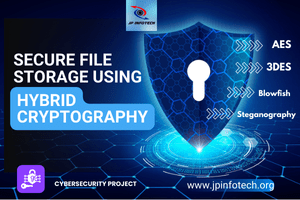
Secure File Storage Using Hybrid Cryptography
Secure File Storage Using Hybrid Cryptography
ABSTRACT:
Secure digital data storage has become a critical requirement in modern information systems due to the rapid growth of cloud-based applications and increasing threats such as data breaches, unauthorized access, and cyberattacks. Traditional storage mechanisms often rely on single-layer encryption, which may not be sufficient to protect highly sensitive user data. This project, titled “Secure File Storage Using Hybrid Cryptography” focuses on strengthening data confidentiality, controlled access, and secure sharing by integrating multiple cryptographic and data-hiding techniques into a unified web-based system.
The need for this system arises from the limitations of conventional file storage platforms that expose encryption keys, lack fine-grained sharing control, and provide minimal visibility into system usage. Users require a secure environment where files are protected not only during storage but also during transmission and sharing. Additionally, administrators need comprehensive analytical insights to monitor user activity, file usage, and system performance for effective management and auditing.
The developed system is implemented using Java as the core programming language, with JSP, CSS, and JavaScript for the frontend and MySQL as the backend database. Each user undergoes a secure registration process and is assigned a unique encrypted identity to ensure authenticated access. Uploaded files are automatically divided into three blocks and protected using a triple encryption mechanism that combines AES, 3DES, and Blowfish algorithms, significantly enhancing data security. To further strengthen protection, the decryption key is embedded within an image using advanced LSB-based steganography, ensuring that the key is never exposed directly.
The system supports controlled file sharing, where encrypted files can only be accessed by authorized users possessing the correct stego-image. File recovery is designed to be user-friendly, allowing users to upload the steganographic image and retrieve decrypted files in a single step while maintaining full data integrity verification. An integrated admin module provides detailed system monitoring through dashboards that include user statistics, encrypted file analytics, sharing and download reports, and advanced visual analytics such as six-month trends, data distribution charts, activity balance radar graphs, and operational comparisons.
Overall, the project delivers a robust, secure, and scalable file storage solution that effectively combines hybrid cryptography, steganography, and administrative analytics to address modern data security challenges.
PROJECT OUTPUT VIDEO:
EXISTING SYSTEM:
- The existing system for secure file storage primarily relies on conventional encryption-based mechanisms integrated into web or cloud storage platforms. These systems are designed to store user files in encrypted form to protect data confidentiality during storage and transmission. Users typically register with basic authentication credentials and upload files, which are then encrypted using a single cryptographic algorithm before being stored in centralized servers or databases.
- Most existing solutions implement well-known symmetric or asymmetric encryption techniques such as AES, 3DES, or RSA to safeguard files. Files are encrypted before storage and decrypted during download, ensuring that stored data remains protected from unauthorized access at the server level. Encryption key management is typically handled by the application or server, allowing seamless encryption and decryption operations without direct user intervention. These approaches ensure that stored data remains unreadable to unauthorized users and protect files during download or transfer operations.
- File sharing in existing systems is generally handled through conventional permission-based access control. Once access is granted, authorized users can download or view files through standard authentication checks. The encryption and decryption processes are typically transparent to users, enabling seamless interaction with the storage platform.
- From an administrative perspective, existing systems provide basic monitoring and management features. Administrators can view registered user details, monitor file uploads and downloads, and track storage utilization. Some platforms also offer simple statistical reports or dashboards displaying total users, stored files, and overall storage consumption to support system maintenance and operational oversight.
- Overall, the existing system establishes a foundational framework for secure digital file storage by combining user authentication, encryption-based data protection, controlled sharing mechanisms, and basic administrative monitoring within a centralized web-based environment.
DISADVANTAGES OF EXISTING SYSTEM:
- Single-Layer Encryption Dependency: In the existing system, file storage systems rely on a single encryption algorithm such as AES or RSA for protecting files. If the encryption key is exposed or compromised, the entire file becomes vulnerable, as there is no additional cryptographic layer to reinforce security.
- Centralized Key Management: In existing systems, encryption and decryption keys are often stored or managed centrally by the application or server. This creates a single point of trust where key exposure can lead to unauthorized data access. Users have limited control over how keys are generated, stored, or protected.
- Lack of Advanced Data Hiding: The existing system focus only on encryption and do not incorporate data-hiding techniques. Encryption keys or access credentials are typically transmitted or stored explicitly, making them potential targets during interception or insider attacks.
- Limited Secure Sharing Mechanisms: File sharing in existing systems is mainly permission-based, relying on user credentials or roles. Once access is granted, the shared file can be downloaded directly, offering minimal protection against misuse, forwarding, or unauthorized redistribution.
- Minimal Integrity Verification: Existing systems generally emphasize confidentiality but provide limited mechanisms to verify whether a file has been altered or tampered with during storage or transfer. Integrity checks, if present, are often basic and not tightly integrated with the decryption process.
- Basic Administrative Analytics: Administrative dashboards in the existing system usually provide only high-level statistics such as total users or storage usage. Detailed analytical insights into user behavior, sharing patterns, download trends, and system activity over time are often limited or unavailable.
- Scalability and Security Balance: As the number of users and stored files increases, existing systems may struggle to balance performance and security. Encryption operations, access validation, and monitoring features are not always optimized for large-scale usage with enhanced security requirements.
Overall, while the existing system establishes fundamental secure storage functionality, these limitations highlight the need for a more layered, intelligent, and analytics-driven approach to file security and management.
PROPOSED SYSTEM:
- The proposed system introduces a comprehensive and secure web-based file storage framework that integrates hybrid cryptography, steganography, and controlled access management to protect sensitive digital data. The system is developed using Java as the core programming language, with JSP, CSS, and JavaScript for the user interface and MySQL for secure data management and persistence. It is designed to handle secure file upload, storage, sharing, and retrieval while maintaining strict authentication and monitoring mechanisms.
- User access begins with a secure registration and login process, where each user is assigned a unique encrypted identity. This identity is used to authenticate user actions such as file uploads, downloads, and sharing requests. Once authenticated, users can upload files into the system, where each file is automatically divided into three independent blocks to support layered protection.
- The core of the proposed system is a hybrid encryption mechanism. Each file block is encrypted using a different symmetric encryption algorithm, namely AES, 3DES, and Blowfish. This multi-algorithm approach ensures that file data is processed through multiple cryptographic transformations before storage. The encrypted blocks are then securely stored in the database or file server with proper indexing and metadata management.
- To protect the encryption keys, the proposed system incorporates LSB-based steganography, where the generated decryption key is hidden inside a user-selected image file. This stego-image acts as the only medium through which the encrypted file can be decrypted. The key is never stored or transmitted in plain form, and access to the file strictly depends on the availability of the correct image.
- The system also supports controlled file sharing, allowing users to share encrypted files with other registered users. Shared files remain encrypted, and recipients must possess the corresponding stego-image to perform decryption. This ensures that file access is tightly bound to both user authentication and key possession.
- For file recovery, users upload the stego-image through the interface, after which the system extracts the hidden key, decrypts the file blocks, and reconstructs the original file. Integrity verification is performed during this process to ensure that the retrieved file matches the original uploaded content.
- An integrated admin module provides centralized system oversight. Administrators can view analytical summaries such as total registered users, encrypted files, shared files, downloads, and overall storage usage. Additional admin views include detailed user profiles, file activity statistics, sharing status reports, and download logs. The system also generates dynamic visual analytics, including six-month activity trends, data distribution charts, activity balance radar graphs, and operation-wise comparisons, supporting effective monitoring and system management.
ADVANTAGES OF PROPOSED SYSTEM:
- Enhanced Multi-Layer Data Security: The proposed system applies a hybrid cryptographic approach by combining multiple encryption algorithms such as AES, 3DES, and Blowfish. Encrypting different file blocks with different algorithms significantly strengthens data confidentiality and reduces the risk of complete data exposure.
- Secure Key Protection Using Steganography: By embedding the decryption key inside an image using LSB steganography, the proposed system ensures that cryptographic keys are never stored or transmitted explicitly. This hidden-key mechanism adds an additional layer of security beyond conventional encryption methods.
- Strong User Authentication and Identity Management: In the proposed system, each user is assigned a unique encrypted identity during registration, ensuring secure authentication and preventing unauthorized access. This approach enhances accountability and traceability for all file-related operations within the system.
- Controlled and Trusted File Sharing: In the proposed system, the file sharing mechanism enforces strict access control by requiring both user authentication and possession of the correct stego-image. This ensures that shared files can only be decrypted and accessed by intended recipients, maintaining confidentiality during collaboration.
- Reliable File Integrity and Recovery: The proposed system verifies data integrity during the decryption and reconstruction process, ensuring that retrieved files are accurate and unaltered. One-click recovery using the stego-image simplifies the retrieval process while maintaining secure validation.
- Comprehensive Administrative Monitoring: The admin module offers detailed analytics covering users, files, shares, downloads, and storage usage. Dynamic visual reports such as trend analysis, data distribution, and operational comparisons provide administrators with clear insights into system behavior and performance.
- Scalability and Efficient Management: The proposed system modular design, combined with secure backend processing using Java and MySQL, allows the system to handle increasing numbers of users and files efficiently. This ensures consistent performance while maintaining high security standards across the platform.
Overall, the proposed system delivers a secure, reliable, and well-monitored file storage solution by integrating hybrid cryptography, steganography, controlled access, and advanced administrative analytics.
SYSTEM REQUIREMENTS:
HARDWARE REQUIREMENTS:
- System : Pentium i3 Processor.
- Hard Disk : 20 GB.
- Monitor : 15’’ LED.
- Input Devices : Keyboard, Mouse.
- Ram : 8 GB.
SOFTWARE REQUIREMENTS:
- Operating system : Windows 10/11.
- Coding Language : Java.
- Frontend : JSP, CSS, JavaScript.
- JDK Version : JDK 23.0.1.
- IDE Tool : Apache Netbeans IDE 24.
- Tomcat Server Version : Apache Tomcat 9.0.84
- Database : MySQL.
👉CLICK HERE TO BUY THIS PROJECT “Secure File Storage Using Hybrid Cryptography” SOURCE CODE👈
Frequently Asked Questions (FAQ’s) and Answers
The purpose of this project is to provide a highly secure platform for storing, sharing, and retrieving digital files by combining multiple encryption algorithms with steganography. It ensures data confidentiality, controlled access, and integrity verification for sensitive information.
The system is developed using Java as the backend language, JSP, CSS, and JavaScript for the frontend, and MySQL as the database. It is deployed on a Java-compatible web server such as Apache Tomcat.
Hybrid cryptography refers to the use of multiple encryption algorithms together to secure data. In this project, uploaded files are divided into blocks and encrypted using AES, 3DES, and Blowfish, providing multi-layer security.
The encryption key is hidden inside an image using LSB-based steganography. This image, called a stego-image, is required for decryption and is not stored or transmitted in plain text, ensuring secure key management.
Files are shared in encrypted form with selected registered users. To access a shared file, the recipient must be authenticated and must upload the correct stego-image that contains the hidden decryption key.
No. Even if a user has login access, the file cannot be decrypted or viewed without the correct stego-image. This ensures strict access control and prevents unauthorized data access.
If an incorrect or invalid stego-image is uploaded, the system fails to extract the correct key and blocks the decryption process, ensuring that file security is maintained.
During the recovery process, the system verifies the integrity of decrypted file blocks before reconstructing the original file. This ensures that the retrieved file is accurate and unaltered.
Administrators can view user details, file statistics, sharing and download analytics, and overall system activity. The admin module also provides dynamic graphical reports such as six-month trends, data distribution, activity balance radar, and operation comparisons.
Yes. The system is designed using a modular architecture with Java and MySQL, allowing it to scale efficiently as the number of users and stored files increases.
The system supports common file types such as documents, images, and text files. File validation mechanisms ensure safe and secure uploads.
Yes. The system maintains detailed logs for file uploads, downloads, and sharing activities, which are accessible through the admin analytics module. Q1. What is the purpose of the Secure File Storage Using Hybrid Cryptography project?
Q2. Which technologies are used to develop this system?
Q3. What is meant by hybrid cryptography in this project?
Q4. How is the encryption key protected in the system?
Q5. How does secure file sharing work in this system?
Q6. Can a file be accessed without the stego-image?
Q7. What happens if an incorrect stego-image is uploaded during decryption?
Q8. How is data integrity ensured during file recovery?
Q9. What features are available for administrators?
Q10. Is the system scalable for large numbers of users and files?
Q11. What types of files can be uploaded to the system?
Q12. Does the system maintain logs of user activity?

You may also like
Detection of Hate Speech on Social Media Using Sentiment Analysis

Racism Detection on Twitter Using Stanford NLP
