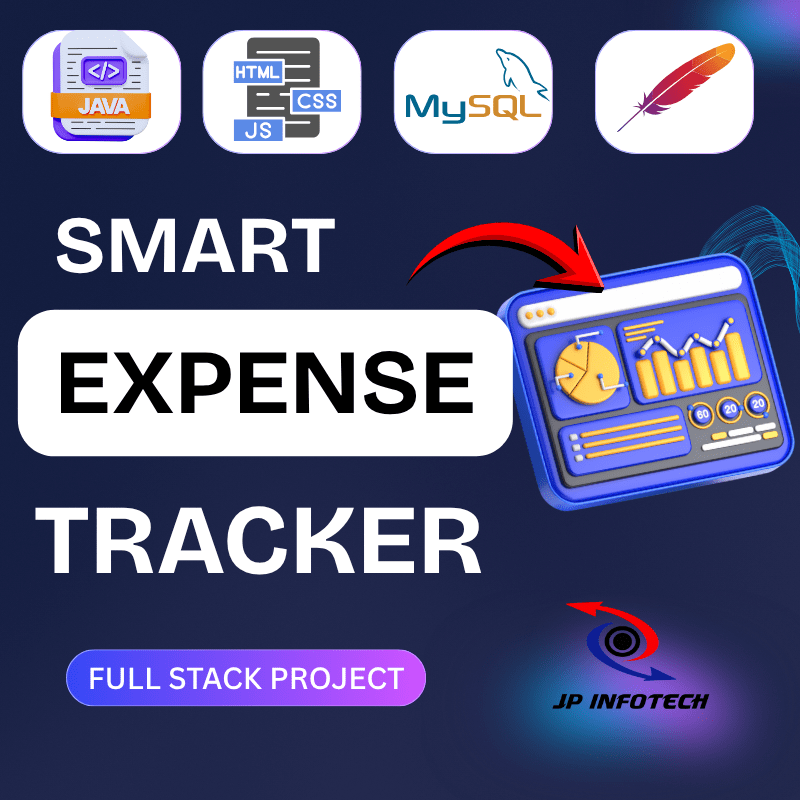
Smart Expense Tracker System
Smart Expense Tracker System
ABSTRACT:
In today’s fast-paced and digitally driven world, managing personal finances effectively has become an essential aspect of maintaining financial stability. With the increasing number of daily transactions, ranging from online payments to utility bills and purchases, individuals often find it challenging to monitor their expenses and incomes accurately. Manual tracking through notebooks or spreadsheets is time-consuming, prone to human errors, and lacks analytical insight. To address these challenges, technology-based financial management tools have become a growing necessity, offering automated, reliable, and user-friendly solutions for expense management.
The Smart Expense Tracker System is a web-based application developed to simplify and automate the process of personal financial tracking. This system provides users with an organized platform to record, manage, and analyze their daily financial activities efficiently. Developed using Java as the coding language with JSP, CSS, and JavaScript for the frontend and MySQL as the database, the system ensures robust performance, scalability, and data integrity. The primary objective of this project is to help users gain better control over their financial habits by categorizing transactions, visualizing spending patterns, and maintaining accurate records of income and expenses.
The system enables users to manage the categories while automatically classifying them under predefined categories such as Others, Transport, Health, Shopping, and Utilities. It also incorporates features for importing digital payment statements (e.g., Google Pay PDFs), automatically extracting transaction details, and mapping them to relevant categories using intelligent keyword-based logic. The interactive dashboard provides visual insights through charts and summaries, displaying monthly income-expense comparisons, category-wise expenditure, and overall balance. Additionally, the system supports budget management, allowing users to set spending limits for each category and receive alerts when nearing those limits.
Overall, the Smart Expense Tracker System serves as an intelligent financial assistant, helping users develop better budgeting discipline and awareness of their financial behavior. By leveraging modern web technologies and database-driven automation, the system minimizes manual effort and maximizes accuracy, making personal finance management simple, efficient, and insightful. This project demonstrates the integration of web development and database technologies to build a practical, user-centric, and effective financial tracking solution suitable for everyday use.
PROJECT OUTPUT VIDEO:
EXISTING SYSTEM:
- The existing system for managing personal financial records primarily relied on traditional and manual methods such as maintaining handwritten logs, using spreadsheets, or employing basic mobile note-taking applications. In this approach, individuals recorded their daily expenses, incomes, and bills manually, either in physical notebooks or simple digital formats. Financial data was often organized by date or category, requiring the user to perform calculations and summaries manually. While such systems provided a fundamental way to monitor finances, they depended heavily on user input and discipline for accuracy and consistency.
- In addition to manual tracking, some users adopted spreadsheet software like Microsoft Excel or Google Sheets to store and calculate their financial data. These spreadsheets allowed for the use of basic formulas and templates to compute totals and averages, helping users maintain a clearer view of their financial transactions. In more recent developments, a few standalone desktop-based financial tools emerged, offering expense tracking, simple data entry forms, and static reports. These systems, though somewhat automated, were generally designed for single-device use and lacked real-time accessibility or integration with online financial sources.
- Overall, the existing systems provided users with a means to manage their personal finances in a basic yet structured way. They supported record-keeping, enabled users to analyze their expenditure trends to a certain extent, and offered an initial foundation for financial awareness and discipline. These methods served as an important stepping stone toward the development of more advanced, automated, and user-friendly expense tracking systems.
DISADVANTAGES OF EXISTING SYSTEM:
While the existing systems for managing personal finances offered a basic means of recording and organizing transactions, they possessed several limitations that reduced their efficiency and reliability. The following are the major disadvantages of the existing system:
- Manual Data Entry and Time Consumption: In the existing expense tracking process, users had to manually enter every transaction, including the amount, category, and date. This not only consumed significant time but also required consistent effort and discipline. For individuals with multiple daily transactions, maintaining updated records became tedious and often led to incomplete or outdated entries.
- Lack of Automation: The existing systems lacked in automation, which doesn’t support features like uploading Gpay Transaction statement options. Users had to manually assign enter all the transactions which are done in Gpay for every entry. Moreover, there were no intelligent features to analyze patterns or generate financial insights automatically. The absence of automation made the process repetitive and less efficient.
- Error-Prone Calculations: Since most existing systems relied on manual entry and user-defined formulas (in the case of spreadsheets), they were prone to human errors. Mistakes in data entry or calculation could lead to incorrect totals, misrepresented spending reports, and unreliable financial summaries, ultimately reducing the accuracy of financial analysis.
- Limited Data Visualization and Insights: In the existing system, Manual logs or spreadsheets generally presented data in tabular form without interactive or graphical representations. Users had to create charts manually to visualize their spending patterns. This made it difficult to quickly interpret financial trends, compare monthly expenses, or identify areas of overspending.
- Absence of Real-Time Access and Integration: The existing systems were mostly offline and restricted to a single device or file. They lacked synchronization or integration with digital payment systems, such as Google Pays statements. As a result, users could not import transaction data automatically or access their records from multiple devices, limiting convenience and flexibility.
- Inefficient Record Management and Storage: In the existing manual or file-based systems, maintaining long-term financial records and retrieving past transactions required searching through numerous entries or files. Over time, as the volume of data grew, organizing and managing these records became increasingly difficult, leading to inefficiencies in record retrieval and data management.
Overall, the disadvantages of the earlier systems highlight the need for a more automated, secure, and intelligent approach to expense management. These limitations served as the motivation behind the development of the Smart Expense Tracker System, which integrates automation, analytics, and real-time data handling for efficient financial management.
PROPOSED SYSTEM:
- The Smart Expense Tracker System is a web-based application designed to automate and simplify the process of managing personal financial records. It provides users with a centralized and intelligent platform to record, monitor, and analyze their income and expenses effectively. The system is developed using Java as the programming language, with JSP, CSS, and JavaScript for the frontend interface and MySQL as the backend database for secure and structured data storage. The system ensures efficient data handling, user authentication, and a smooth user experience through its modular and responsive design.
- In the proposed system, users can register, log in, and securely access their personalized financial dashboard. The system enables users to manage the category of the transactions while associating each entry with specific categories such as Food, Health, Transport, Shopping, Entertainment, and Utilities. Users can also specify whether a transaction is an income or an expense, allowing the system to compute overall balance and generate summaries dynamically. The database stores all transactional details, ensuring persistence and consistency of financial records.
- A key component of the proposed system is its automated statement processing feature, where users can upload digital payment statements such as Google Pay transaction PDF and the system intelligently extracts and categorizes the data using keyword-based recognition logic. This minimizes manual input and helps maintain accurate transaction histories. Additionally, the system provides a user-friendly dashboard that visually represents financial data through interactive charts and graphs, allowing users to gain insights into their monthly trends and category-wise spending patterns.
- The proposed system also integrates a budget management module, allowing users to define spending limits for each category and monitor their utilization. This helps users stay within their planned budgets by providing real-time updates and alerts when expenses approach defined limits. The entire application operates over a secure authentication framework, ensuring that only authorized users can access and manage their data.
- Overall, the proposed system delivers a structured, digital, and automated environment for personal finance tracking. By combining efficient data management, intelligent transaction classification, and interactive reporting, the Smart Expense Tracker System provides users with an advanced solution to monitor their financial activities and maintain control over their daily expenses.
ADVANTAGES OF PROPOSED SYSTEM:
The Smart Expense Tracker System offers several significant advantages over the earlier manual and semi-automated methods of managing personal finances. By combining automation, analytics, and an intuitive user interface, the proposed system enhances both efficiency and accuracy in financial tracking. The following are the major advantages of the developed system:
- Automation of Financial Tracking: The proposed system eliminates the need for manual data entry by automating the recording and classification of transactions. Through its integrated statement upload feature, users can import digital payment statements such as Google Pay transaction PDFs, and the system intelligently extracts details like date, description, amount, and transaction type. This automation reduces human effort and ensures that financial records remain accurate and up to date.
- Efficient Data Management and Storage: In the proposed system, by utilizing MySQL as the backend database, the system ensures secure, structured, and reliable storage of all financial records. Users can easily retrieve, modify, or delete transactions whenever needed. The centralized database design allows smooth data handling and minimizes redundancy while maintaining consistency across different modules.
- Categorization and Organized Record-Keeping: In the proposed system, each transaction is categorized automatically or manually under predefined types such as Food, Transport, Shopping, or Utilities. This organized classification allows users to easily analyze their spending patterns and identify how much they are allocating to each expense category. Such structured data management improves transparency and financial awareness.
- Visual Analysis through Interactive Dashboard: The proposed system incorporates an interactive and visually appealing dashboard developed using JSP, CSS, and JavaScript. It displays income and expense data using charts and graphs, such as pie charts and bar graphs, offering users an at-a-glance understanding of their financial activities. Visual representation simplifies complex financial data and helps users make informed decisions.
- Budget Monitoring and Financial Control: In the proposed system, an integrated budget management module allows users to set spending limits for each category and monitor their budget utilization in real time. The system notifies users when they are close to exceeding their predefined budget, enabling them to maintain financial discipline and avoid overspending.
- Accessibility and User-Friendly Interface: Being a web-based application, the Smart Expense Tracker System can be accessed from any device with an internet connection when hosted in online web server. Its responsive and intuitive user interface, designed using CSS and JavaScript, ensures a smooth user experience. Navigation between modules is simple, allowing even non-technical users to manage their finances effortlessly.
- Accurate Calculations and Real-Time Reports: The proposed system performs automatic calculations for total income, total expenses, and balance in real time. Users can instantly view summaries and generate category-wise or monthly reports without the risk of manual errors. This ensures precision in financial tracking and helps users make data-driven financial decisions.
- Enhanced Security and Authentication: The proposed system implements secure login mechanisms, ensuring that only authorized users can access their financial data. It prevents unauthorized access and data manipulation, providing users with a reliable and confidential environment for managing their finances.
- Scalability and Flexibility for Future Enhancements: The architecture of the system is modular and scalable, allowing for easy integration of new features in the future.
In summary, the Smart Expense Tracker System provides users with a modern, automated, and analytical approach to managing personal finances. It ensures accuracy, enhances convenience, improves financial awareness, and promotes disciplined spending habits, making it a highly effective solution for individuals seeking better financial management in a digital era.
SYSTEM REQUIREMENTS:
HARDWARE REQUIREMENTS:
- System : Pentium i3 Processor.
- Hard Disk : 20 GB.
- Monitor : 15’’ LED.
- Input Devices : Keyboard, Mouse.
- Ram : 8 GB.
SOFTWARE REQUIREMENTS:
- Operating system : Windows 10/11.
- Coding Language : Java.
- Frontend : JSP, CSS, JavaScript.
- JDK Version : JDK 23.0.1.
- IDE Tool : Apache Netbeans IDE 24.
- Tomcat Server Version : Apache Tomcat 9.0.84
- Database : MySQL.
👉CLICK HERE TO BUY THIS PROJECT “Smart Expense Tracker System” SOURCE CODE👈
Frequently Asked Questions (FAQ’s) and Answers
The Smart Expense Tracker System is a web-based application designed to help users efficiently manage their personal finances. It allows users to record their income and expenses, categorize transactions, set budgets, and visualize financial data through interactive charts and reports. The system simplifies financial tracking and provides users with clear insights into their spending habits.
The project is developed using the following technologies: • Programming Language: Java • Frontend: JSP (Java Server Pages), CSS, JavaScript • Backend Framework: Java Servlets • Database: MySQL • Web Server: Apache Tomcat • PDF Processing Library: Apache PDFBox (for GPay statement upload feature) These technologies ensure a secure, efficient, and dynamic web application.
The main objective of the Smart Expense Tracker System is to automate and simplify the process of personal finance management. It aims to provide users with a convenient platform to track income and expenses, analyze spending patterns, set budgets, and make informed financial decisions.
This system is designed for individual users who wish to manage their personal finances efficiently. It is suitable for working professionals, students, and families who want to monitor daily expenses, track income sources, and maintain better financial discipline.
Yes. The system allows users to upload Google Pay (GPay) PDF statements. The uploaded file is processed using the Apache PDFBox library, which extracts transaction details such as date, description, amount, and type (Income/Expense). The system then automatically inserts this data into the database with relevant categories assigned.
All user transactions and financial data are securely stored in a MySQL database. Each record is linked to a specific user through a unique user ID, ensuring that data remains private and accessible only to the respective account holder.
The user dashboard provides an overview of key financial metrics and visualizations, including: • Total Income, Total Expense, and Balance Summary • Income vs. Expense Comparison Chart • Category-wise Expense Distribution Pie Chart • Monthly Expense Trends • Budget Utilization Overview
The system allows users to set budget limits for different categories, such as Food, Transport, or Shopping. As users add expenses, the system tracks the total amount spent and compares it to the allocated budget. When spending approaches or exceeds the set limit, the system alerts the user to help maintain financial control.
Unlike manual logs or spreadsheets, this system automates financial tracking, categorization, and reporting. It provides instant insights through interactive dashboards, eliminates manual calculations, and ensures accurate and organized financial record management.
The system consists of the following modules: • User Authentication Module • Transaction Management Module • Category Management Module • Budget Management Module • Statement Upload and Processing Module • Dashboard and Reporting Module Each module contributes to creating a complete, integrated personal finance management solution.
By providing visual insights into income and expenses, the system helps users identify spending patterns and control unnecessary expenditures. It also highlights areas of overspending and enables users to plan budgets more effectively, leading to improved financial awareness and savings.
The primary benefit of the Smart Expense Tracker System is that it automates the entire financial tracking process: saving users time, improving accuracy, and offering valuable insights for better money management. It helps users stay organized, maintain budgets, and gain full control over their financial activities in an easy and efficient way. 1. What is the Smart Expense Tracker System is about?
2. What technologies are used in developing this project?
3. What is the main objective of this project?
4. Who can use this system?
5. Can users upload their Gpay payment statements?
6. How is the user’s financial data stored and managed?
7. What features are available in the user dashboard?
8. How does the budget management feature work?
9. How is this system different from traditional expense tracking methods?
10. What are the key modules of the system?
11. How does the system help users make better financial decisions?
12. What is the primary benefit of using this system?

You may also like
EV Charging Station Finder and Slot Booking
Cybersecurity Incident Reporting and Tracking System